Crowd duty is an odd kind of police work. The people in front of you are, almost all of them, not a threat. They’re fans outside a stadium, families at a festival, workers at a rally. Your job is to keep things calm, keep people safe, and only step up the response if something actually changes.
Getting that balance right takes practice. Officers have to hold a line, talk to each other, read the mood of a few hundred people and decide when to push and when to give ground. It’s a lot to do at once.
KOMINA has a Crowd Control scenario built for this, described as mass gathering management with escalation and de-escalation tactics. Here’s how it works in VR and where it’s genuinely useful.
Why It’s So Hard to Train for Real
To make a live crowd control exercise feel real, you need a crowd. That means dozens of volunteers, all of whom need to be recruited, briefed, fed and kept safe. Even then, safety rules limit how much they can push, surge or throw things, and after a couple of runs they start doing the same thing every time.
So a lot of units end up practising formations on an empty parade ground. The first time many officers face a real, restless crowd is on an actual deployment. That’s quite a jump.
A Crowd That Doesn’t All Behave the Same
KOMINA’s NPC spawner fills a scene with civilian AI agents, and each one can be set as panicked, compliant or unpredictable. The interesting part is mixing them. A crowd that’s mostly calm with a handful of people who suddenly move the wrong way is much closer to real life than a crowd of identical extras.
Instructors can also drop in hostile agents (aggressive, defensive or ambush) for scenarios where someone in the gathering is armed. And there are friendly law enforcement agents, set as supportive, coordinated or independent. That means a small group of trainees can work as part of a bigger police line, with AI officers filling the rest of the positions.
Setting the Scene
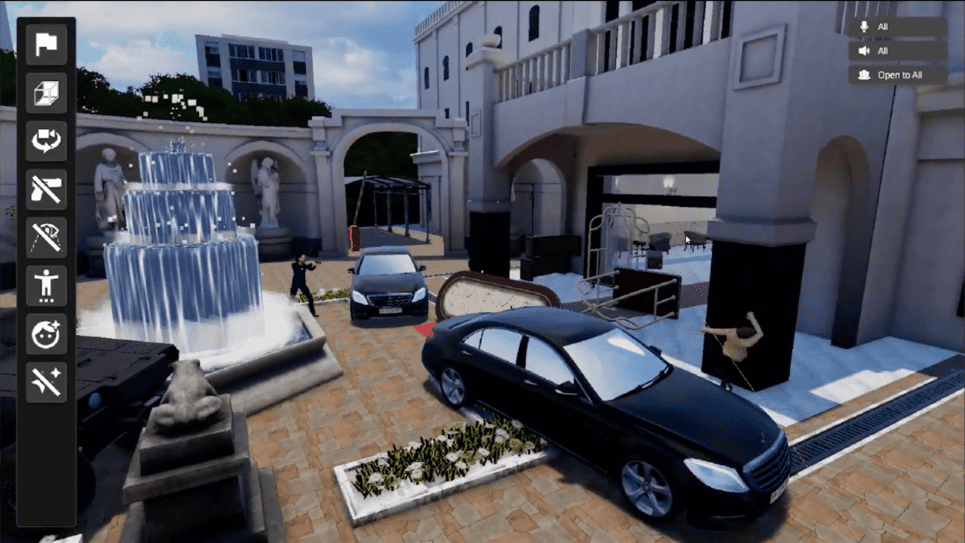
Crowds gather in particular places: a square in front of a government office, a stadium gate, a busy junction, a market. With the map editor, instructors can lay out streets, barriers, buildings and parked vehicles from the asset library, and use the terrain editor for slopes and obstacles.
The sandbox lets them change things during the run. Block an exit. Roll a vehicle into the square. Bring the light down to dusk. Each change asks the same question of the unit: do you adjust, or do you stick to the plan you had five minutes ago?
Seeing the Line From Above
Small positioning mistakes cause big problems in crowd work. An officer who steps forward alone. A gap in the line. A cordon that leaves people nowhere to go, which tends to turn a calm crowd into a frightened one.
KOMINA tracks every trainee’s position and posture through full-body motion capture. From the top-down view, the instructor can watch the whole arena and every officer in it. Afterwards, the after-action review offers a 3D replay, heatmaps, movement pattern analysis and team synchronisation data. You can see the exact moment the line broke, and who moved.
If force was used, the replay shows what the person in the crowd was doing at that moment, from any angle, including the officer’s own field of view through the cone view. That makes for a much fairer and more specific debrief.
Keeping a Cool Head
Proportional response is easy to talk about and hard to do when you feel cornered. KOMINA’s heart rate monitoring and stress tracking show instructors how each officer reacted as the scene heated up. Put that next to the replay and you often find the reason an officer escalated early, which is far more useful than a general “stay calm next time”.
What VR Can’t Do Here
It won’t replace shield work, protective equipment or physical formation drills. Officers need to feel the weight of the kit and the push of a line, and that only happens in person. KOMINA itself frames virtual training as something that fills gaps in traditional training, not something that replaces it.
Crowd Control Training in VR: Practicing Formation, Positioning and RestraintWhat it does offer is a crowd that behaves differently every time and a recording of every decision. For units that police demonstrations, matches and big public events, that’s hard to get any other way. The KOMINA team can show the Crowd Control scenario in a demo.