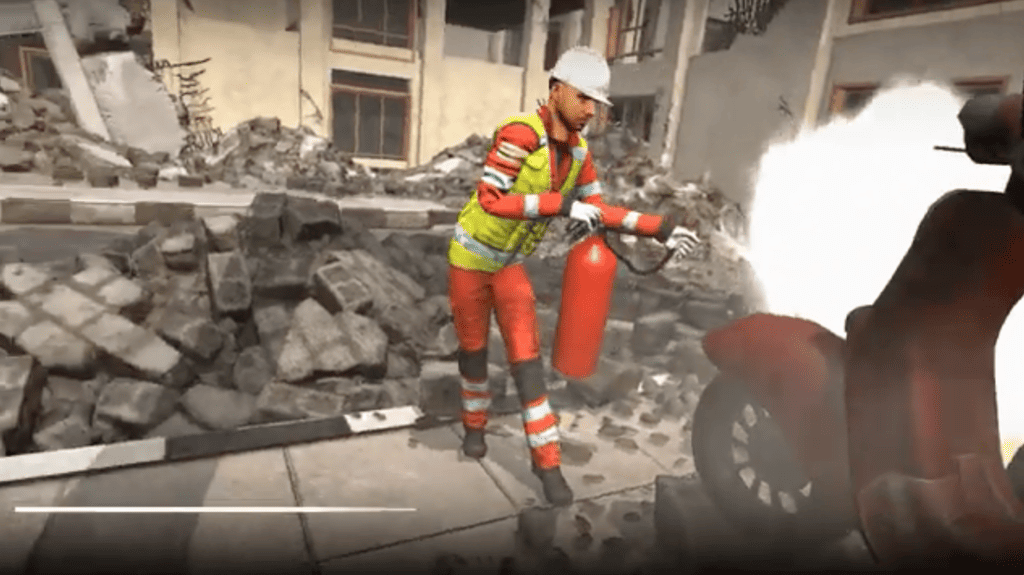
Picture this: an employee approaches the fire extinguisher mounted on the wall, pulls the pin, aims the nozzle — and then freezes. Because they’ve completed the training course. They passed the assessment. They know the PASS technique in theory. But they’ve never actually held a fire extinguisher while a fire was in front of them, and the knowledge that lives in their notebook does not automatically live in their hands.
This is one of the most well-documented gaps in workplace safety — the distance between theoretical knowledge and practical competence in emergency situations. And VR safety training for fire is one of the most effective tools currently available for closing it.
The Fundamental Problem With Safe Training
There’s an inherent paradox at the center of fire safety training.
On one hand, the skills required to respond effectively to a fire emergency — correct extinguisher selection, proper technique, situational assessment under stress — can only be truly learned through practice. Reading about fire response doesn’t build it. Watching a video doesn’t build it. Practice builds it.
On the other hand, practicing fire response with real fire is dangerous. Controlled burn training exercises, while valuable, expose trainees to heat, smoke, and physical risk. They require specialized facilities, qualified instructors, significant logistics, and careful safety management. They’re expensive to run at scale and difficult to repeat frequently enough to build durable competence.
The traditional response to this paradox has been to accept a compromise: classroom instruction supplemented by tabletop exercises and occasional extinguisher demonstrations, with live fire practice reserved for specialist roles. The result is a general workforce that knows the theory but lacks the practiced reflexes.
VR safety training for fire resolves the paradox directly. It delivers realistic, high-fidelity practice — the kind that actually builds competence — without any of the physical risk.
What VGLANT’s Fire Training Simulation Delivers
VGLANT’s platform converts your organization’s fire safety SOPs into fully immersive VR training scenarios, accessible at https://vglant.com/. The simulation places trainees inside realistic emergency environments where they must assess a fire situation and respond correctly — selecting the right extinguisher type, applying the correct technique, managing their own positioning and escape route simultaneously.
The training content is structured around the knowledge that actually matters in fire emergencies.
Basic fire knowledge covers the fire chain — fuel, heat, oxygen — and how understanding it informs suppression decisions. Knowing that removing any element of the fire triangle can extinguish a fire isn’t just trivia; it’s the conceptual foundation for understanding why different agents work on different fire classes, and why using the wrong agent can make a situation significantly worse.
Fire extinguisher agents — water, foam, CO2, dry powder, wet chemical — each address specific fire classes and are contraindicated for others. Water on a Class B liquid fire spreads it. CO2 on a Class F cooking oil fire is ineffective and potentially dangerous. VGLANT’s simulation teaches agent selection through direct experience: trainees choose, apply, observe the result, and understand why their choice worked or didn’t.
Extinguishing procedure follows the PASS sequence — Pull, Aim, Squeeze, Sweep — practiced repeatedly in the simulation until the sequence runs automatically. This is the motor pathway that saves lives; it needs to be built through repetition, not memorized from a poster.
The Stress Response Element
One of the most important — and most underappreciated — aspects of VGLANT’s VR safety training for fire is what it does to the trainee’s physiology.
Immersive VR environments, when visually and acoustically convincing, trigger genuine physiological stress response. Heart rate rises. Adrenaline releases. Attention narrows in the characteristic way it does under real threat perception. This happens because the brain’s threat-detection systems operate below conscious reasoning — they respond to the visual and auditory signals of danger before the rational mind has confirmed that the situation isn’t real.
This matters enormously for skill development. Skills practiced under stress are encoded differently — and more durably — than skills practiced in calm, low-stakes settings. More importantly, they’re accessed more reliably when stress is present again. Training that feels real prepares trainees for situations that are real.
VGLANT’s simulations are designed to leverage this mechanism. The fire scenarios are visually convincing, acoustically intense, and time-pressured in ways that activate genuine urgency. The skills trainees develop in this environment transfer to real emergencies more effectively than skills developed in conditions that feel nothing like an emergency.
Trackable, Scalable, Repeatable
Three practical advantages of VR safety training for fire deserve emphasis for safety managers and organizational decision-makers.
Trackable. Every VGLANT training session generates detailed performance data — task duration, correct agent selection, procedure accuracy, decision speed. This data is visualized in an admin dashboard that gives safety managers immediate insight into individual and team readiness. Rather than assuming staff are prepared because they attended a training session, managers have actual evidence of competence — or specific gaps that require remediation.
Scalable. Traditional fire training is constrained by physical resources: training facilities, instructor availability, logistics. VGLANT’s VR platform delivers consistent, high-quality training to any number of trainees without scaling these constraints proportionally. The same simulation runs for ten employees or ten thousand, with the same quality and the same data capture.
Repeatable. Competence attrites without practice. The employee who completed excellent fire training twelve months ago is less prepared than they were immediately after training — not because they’re negligent, but because memory and motor skills both degrade without reinforcement. VGLANT’s platform makes repetition easy and trackable, enabling organizations to maintain genuine readiness rather than just documenting training events.
The Real Measure of Fire Safety Training
The measure of fire safety training isn’t whether your team has completed a course and holds a certificate. It’s whether they can respond correctly — under pressure, in conditions they didn’t anticipate, with the right tool and the right technique — when a fire actually starts.
VR safety training for fire is the most effective tool currently available for building that capability without exposing anyone to actual danger. It combines the realism that procedural skills require with the safety that responsible organizations demand.
Your team shouldn’t encounter their first real fire emergency with nothing but theoretical knowledge and hope. They should arrive at it with practiced reflexes, correct technique, and the confidence that comes from having been inside a simulated version of exactly this situation and handled it successfully.
That preparation is what VGLANT delivers.
Start building genuine fire safety readiness in your organization at https://vglant.com/