Fire drills are a standard part of workplace safety. VR evacuation training is newer. Safety managers sometimes ask whether one can replace the other. In practice, they cover different things. This article compares the two methods so that organisations can decide how to use each.
What a Fire Drill Tests
A fire drill is a planned exercise in which the alarm is sounded and staff evacuate the building. In Indonesia, Minister of Manpower Decree No. KEP.186/MEN/1999 includes holding fire drills as one of the employer’s obligations for fire response.
A drill tests several things at once:
- whether the alarm can be heard in all areas
- whether staff know the escape routes and assembly points
- how long evacuation of the building takes
- whether wardens carry out their duties
- whether the headcount at the assembly point works
Drills are the only way to test the real building, the real alarm system and the real behaviour of the whole workforce at the same time. They also give emergency services and building management a chance to check coordination.
Limits of Fire Drills
Drills also have practical limits:
- They interrupt work, so they are usually held only a few times a year.
- Staff often know a drill is coming, which changes their behaviour.
- Conditions are usually clear: no smoke, no heat and no blocked exits.
- Individual decisions are hard to observe and record.
- Some scenarios, such as a fire at the main stairwell, are difficult to simulate safely.
What VR Evacuation Training Tests
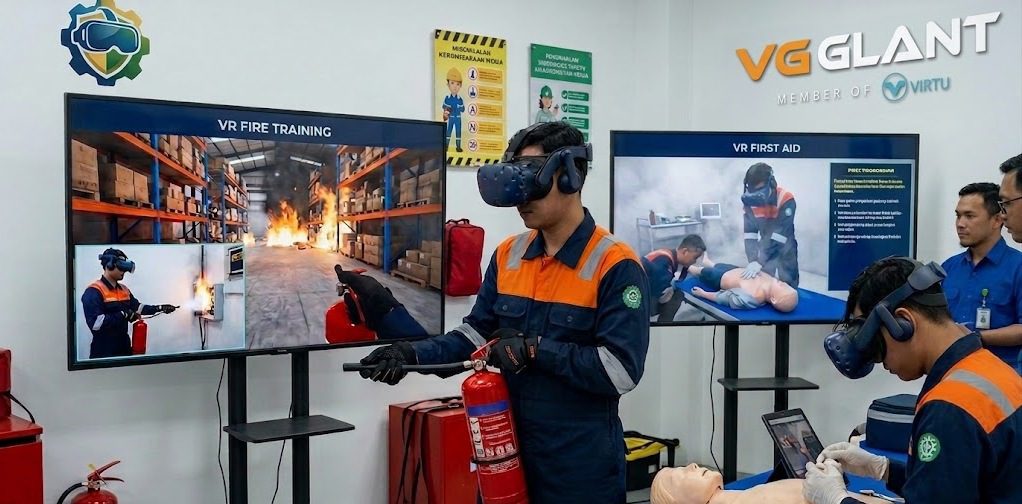
VR evacuation training places an individual or small group in a simulated environment with a fire scenario. The trainee must recognise the situation, decide what to do and move to safety.
VGLANT lists fire evacuation among its VR safety modules. Features listed on its website include randomised scenarios, zero risk exposure and trackable performance, with metrics such as task duration, reaction time and actions taken.
VR training can test:
- whether a person raises the alarm
- whether they choose a safe route
- how they respond when a route is blocked
- whether they avoid lifts
- how they act in reduced visibility
- whether they decide correctly between fighting a small fire and leaving
Limits of VR Evacuation Training
VR training also has limits:
- It does not test the building’s real alarm system or signage.
- It does not measure how long the whole workforce takes to evacuate.
- It depends on how closely the virtual environment matches the real workplace.
- Trainees need time to become familiar with VR equipment.
Side-by-Side Summary
Fire drills are best for testing systems and group behaviour: alarms, routes, headcounts and evacuation time.
VR training is best for testing individual decisions: route choice, response to blocked exits, use of extinguishers and behaviour in smoke.
Drills happen a few times a year with the whole building. VR sessions can be scheduled more often for individuals or small groups.
How to Use Both
A practical approach is to treat VR training as preparation and drills as verification:
- Use VR training to teach and practise individual decisions, especially for new employees and wardens.
- Use fire drills to test whether the building, systems and workforce perform as planned.
- Review drill results and VR data together to identify gaps.
- Use VR scenarios to practise situations found difficult during drills.
Matching the Virtual Environment to the Workplace
VR training is more relevant when the scenario reflects the actual workplace. VGLANT offers ready-to-use products in a portable VR case for standard training, and bespoke services that convert existing SOPs into VR scenarios. A bespoke scenario can follow the organisation’s own escape routes and assembly points.
Recording and Reviewing Results
Drill results are usually recorded as total evacuation time and headcount accuracy. VR training adds individual records. These can show which employees need more practice and which decisions are commonly made incorrectly.
Summary
Fire drills and VR evacuation training answer different questions. Drills test the building and the organisation. VR training tests individual decisions in conditions that drills cannot easily create. Organisations interested in adding VR evacuation training to their program can contact VGLANT to discuss their needs.