Personal Protective Equipment (PPE) for work at height on Indonesian construction sites is regulated through two main regulations: Permenaker No. 8 Tahun 2010 on Personal Protective Equipment, and Permenaker No. 9 Tahun 2016 on K3 in Work at Height. Both regulations set the technical standards for equipment that must be provided, the worker’s obligation to use it, and the inspection obligation before use.
What the regulations do not specify is the training method for building consistent inspection habits. This is the space where VR-based training can function as a complement to conventional training, particularly for the equipment room phase — the phase before a worker reaches the work position, where decisions about PPE selection and inspection are made.
This article covers the components of VR-based PPE selection training for work at height, the data it produces, its limitations, and its position within the Indonesian K3 regulatory framework.
Regulatory Framework
Permenaker 8/2010 (APD) sets the baseline PPE obligations in Indonesian workplaces. Employers are required to provide PPE appropriate to the hazards present, in sufficient quantity, of acceptable quality, with documentation of issuance, and with training on correct use. Workers are required to use the provided PPE during work that warrants it, to report damaged equipment, and to participate in the training provided.
Permenaker 9/2016 (K3 Work at Height) adds the technical requirements for work at height. A full body harness is the required configuration for fall arrest. The lanyard must include a shock-absorbing component capable of limiting fall arrest forces. Connectors must be rated for the application. The harness must fit the worker and be inspected before use.
Formal certification for Tenaga Kerja Bangunan Tinggi 1 and 2 is conducted through training providers recognized by BNSP. VR-based training does not replace this certification pathway; it functions as a complement for competency maintenance between certification cycles.
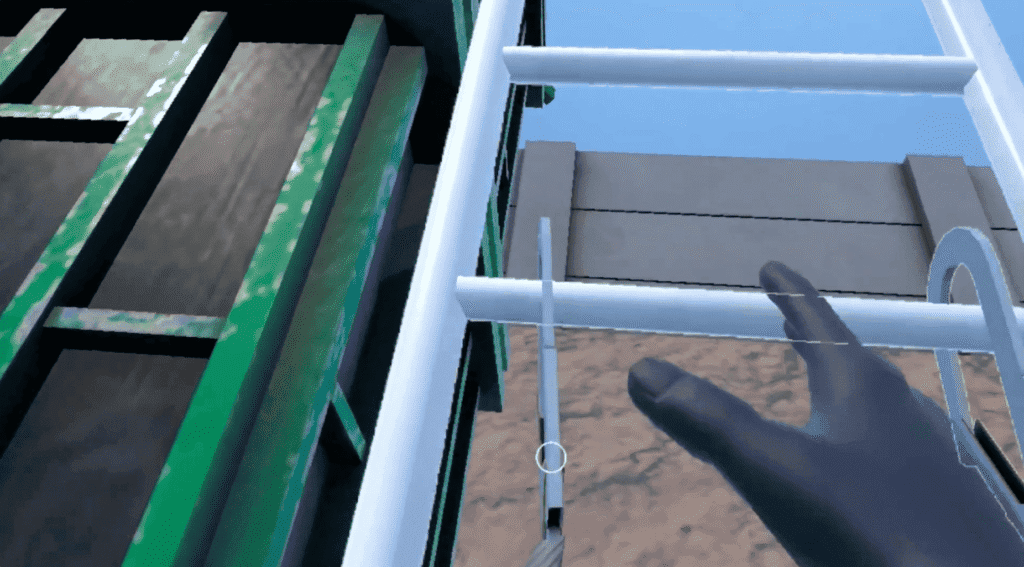
Common Gaps in PPE Inspection
Several common patterns reduce the effectiveness of PPE inspection in the field:
Familiarity with equipment. Workers who have repeatedly used the same harness tend to perform visual inspection automatically. Automatic inspection can miss defects such as frayed straps, separated stitching near the D-ring, or previously deployed shock packs.
Operational time pressure. The PPE distribution window can shrink when the toolbox briefing runs late or when the supervisor wants the crew in position before activity begins. In a compressed window, inspection often isn’t fully performed.
Classroom training without decision points. PPE inspection is typically taught as a checklist in classroom format. Workers can memorize the checklist, but classroom training doesn’t provide the variation in equipment condition that workers encounter in the field — where wear, cleanliness, and condition of PPE all vary.
These three gaps aren’t problems of worker compliance but problems of training design. VR-based training addresses all three by introducing variation in equipment conditions and decision points within every session.
Components of the Equipment Room Scenario in VR
VR scenarios for the equipment room phase simulate the PPE storage area before work begins. The components:
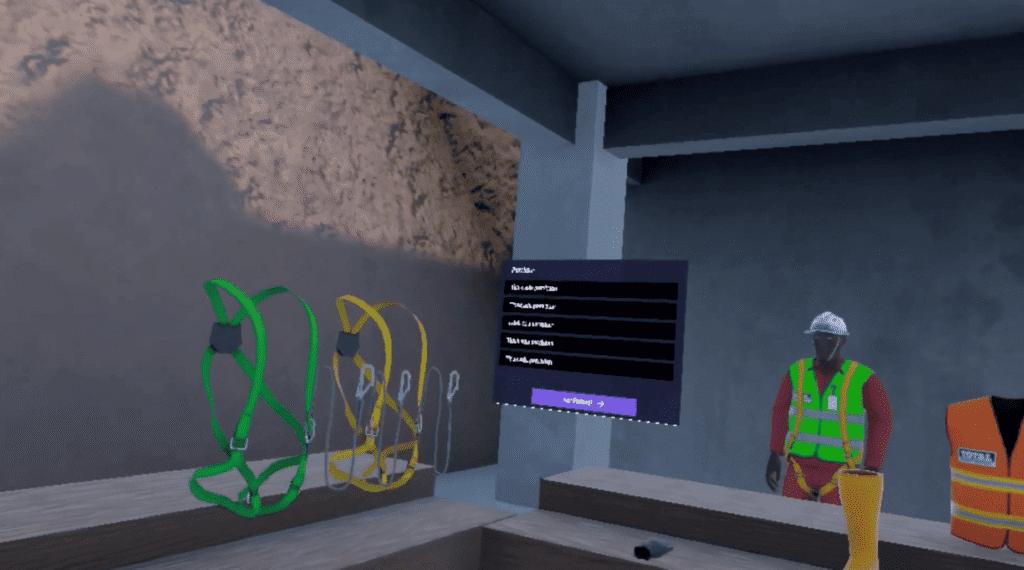
Equipment selection. The trainee sees equipment on the rack — harnesses in various sizes and colors, helmets, vests, footwear, gloves, lanyards, shock packs, and equipment specific to the work. Some options are correct choices; others are not. The trainee must select equipment appropriate to the type of work and their own body size.
Visual inspection. For each selected item, the trainee performs visual inspection by rotating the equipment in the VR environment. The scenario places visible defects on some items: frayed straps, separated stitching, deployed shock packs, helmets with cracks, buckles that don’t latch. The trainee must recognize defects and reject items that aren’t fit for use.
Donning sequence. For the harness, the trainee runs through the correct donning sequence: shoulder straps go on first, the chest strap crosses the sternum at the correct height, leg straps are not twisted, the D-ring on the back is positioned between the shoulder blades, the waist belt (if present) is snug but not restrictive. The system records whether the sequence was performed correctly.
Contractor-specific customization. Scenarios can be adapted to match the equipment issued by a specific contractor. For example, in the VGLANT scenario built for PT Total Bangun Persada, the green and yellow harness, helmet, and vest are modeled to match the equipment used at the actual project site. This improves cognitive transfer from training to the work environment.
Data Produced
Each VR session generates measurable output:
- Equipment selection accuracy: whether the worker chose the right item for the work
- Defect recognition rate: the percentage of defects successfully identified out of those planted in the scenario
- Donning sequence compliance: whether the harness was put on correctly, with straps in the right orientation and buckles latched
- Time to ready state: the interval between entering the equipment room and being correctly equipped for the work
For HSE teams managing workforces of several hundred workers, this data provides visibility that’s hard to achieve through direct supervisor observation. HSE teams can identify workers who are consistently thorough in inspection, workers who tend to skip steps, and areas where refresher training will have the greatest impact.
VR Limitations and the Role of Physical Training
VR-based training has limitations that need to be factored into K3 program planning:
The physical sensation of harness fit doesn’t fully replicate. How the leg straps actually feel against the body, the weight distribution across the shoulders, and the tightness of the chest strap require practice with actual physical equipment. VR is effective for drilling recognition and sequence; the physical fit still needs the real harness.
Tactile inspection cannot be substituted. The tactile difference between worn equipment and serviceable equipment — material texture, strap flexibility, stitching integrity — requires practice with equipment that actually has those conditions.
Formal certification still goes through the accredited pathway. Permenaker 9/2016 requires certification through BNSP-recognized training providers for Tenaga Kerja Bangunan Tinggi 1 and 2 roles.
Site-specific procedures still require location walkthroughs. Every contractor has its own color coding system, inspection schedule, and equipment retirement criteria. These procedures are integrated separately from the generic VR scenarios.
Given these limitations, VR-based training is most effective when positioned as a complement between formal certifications — to maintain inspection competency and preserve consistent operational discipline.
The VGLANT Platform for the Indonesian Work-at-Height Context
VGLANT, built by PT Virtu Digital Kusuma, includes PPE selection scenarios as part of its work at height training catalog. The equipment room phase in this catalog covers:
- Harness selection and fit
- Helmet selection and chin strap inspection
- Vest selection with reflective banding check
- Footwear appropriate to the work
- Lanyard and shock pack inspection
Scenarios can be customized to match the equipment issued by a specific contractor — harness model, color coding for inspection status, helmet style, vest configuration. The protocols align with Permenaker 8/2010 and Permenaker 9/2016, and reference applicable SNI standards.
Hardware runs on standalone Meta Quest headsets, with content licensed annually on a per-seat or per-site basis. The same hardware can be used for other VGLANT modules — fire safety, confined space, hazardous material response, and first aid — which are relevant for meeting broader K3 training needs.
Conclusion
PPE inspection before work at height is a regulatory obligation that’s easy to communicate in classroom training but difficult to maintain consistently in field operations. VR-based training provides a format that addresses the gap between theoretical knowledge and operational habit by introducing equipment condition variation and decision points that are hard to set up in physical training.
For HSE teams and contractors considering VR integration into their K3 programs, the equipment room phase is one of the points with the most measurable operational impact. The implementation doesn’t replace formal certification or physical practice; it closes a training gap that has been difficult to access with conventional methods.