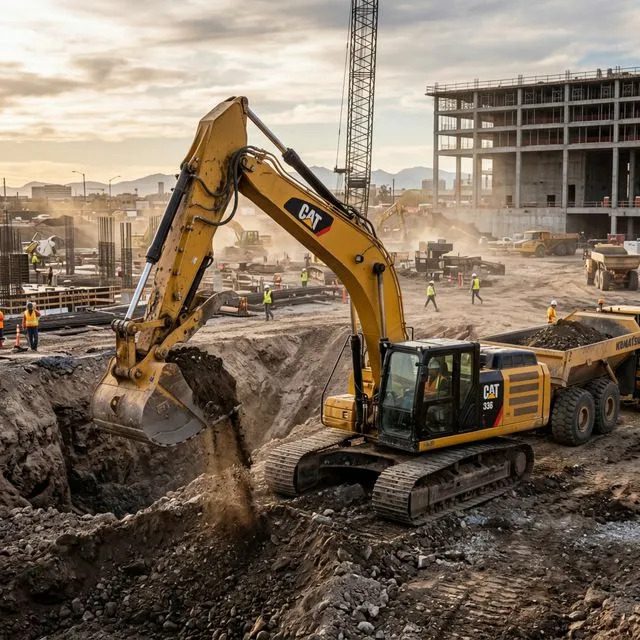
Every mining engineer in Indonesia knows the season they dread. When the rains arrive, an open pit becomes a different and more dangerous place. Haul roads soften and rut. Slopes saturate and grow unstable. Low areas of the pit flood. Visibility drops. Productivity falls as conditions force slowdowns and stoppages, and the risk of an incident climbs at exactly the moment the ground is least forgiving. For a tropical mining country, the wet season isn’t an occasional disruption — it’s a predictable, recurring assault on both safety and output, and how well an operation handles it separates the well-run mines from the rest.
The wet-season problem is an information problem
A lot of what makes the rainy season dangerous comes down to not knowing, quickly enough, what’s changing. Which stretch of haul road has degraded to the point of being unsafe? Where is water pooling? Which slope is showing the early movement that saturation brings? Is a particular area still safe to work, or has it crossed a line? In the dry months these questions have slow, stable answers. In the wet season the answers change by the hour, and a mine relying on periodic manual inspection is always working with information that’s a little out of date — which, on a wet haul road, is how accidents happen.
This is where the “smart mine” idea stops being a buzzword and starts earning its keep. A smart mine is, at its core, an operation that maintains a live, accurate picture of itself — and a live picture is exactly what the wet season demands.
What a digital twin adds in the rain
A digital twin platform keeps a continuously updated 3D model of the operation, fed by sensors and fleet data. During the wet season, that translates into faster awareness of fast-changing conditions. Road and terrain monitoring can flag where haul roads are degrading. Slope monitoring can catch saturation-driven movement early. Real-time fleet tracking shows where equipment is and how it’s moving, so that congestion or risky behavior on slick roads is visible immediately rather than discovered after the fact.
Indonesian developer Virtu has built its smart digital twin around precisely this kind of live operational visibility — fleet telemetry, terrain and road analysis, and automated safety alerts rendered into one view. Built for tropical conditions, the value proposition sharpens in the wet season: when conditions are deteriorating across the pit simultaneously, the operations that cope best are the ones that can see the deterioration as it happens and redirect, slow, or stop the right equipment in the right place — instead of finding out when something goes wrong.
Not a substitute for judgment or drainage
The technology has limits worth stating plainly. A digital twin doesn’t stop the rain, doesn’t drain the pit, and doesn’t replace good water management, sound road construction, and experienced supervisors making conservative calls when conditions warrant. A mine with poor drainage and a beautiful dashboard is still a mine with poor drainage. The platform informs decisions; it doesn’t make the physical problems go away.
But the failure mode it removes is a real one in the wet season: conditions changing faster than the information about them. By compressing the gap between “the road just got dangerous” and “the right people know and act,” a smart-mine platform turns the wettest, riskiest months from a period of flying half-blind into one where the operation can at least see the storm it’s working through. In a country where the rains come every year, that visibility isn’t a luxury. It’s the difference between a hard season and a costly one.
The wet season will always be hard on Indonesian mines. Whether it’s also dangerous and unproductive depends increasingly on how clearly the operation can see itself while the ground is moving.