
There is a fundamental flaw in most Virtual Reality (VR) military training systems today. That flaw is called the “Gamer Mentality.”
When a soldier enters a standard simulation, their subconscious knows a dirty little secret: “If I get shot, nothing happens.” This lack of consequence destroys tactical integrity. Trainees take unrealistic risks. They sprint into open areas like action movie heroes. They neglect to check corners because the cost of failure is zero.
Komina changes the equation. We introduce a controversial but absolutely necessary variable into the simulation: Physical Consequence.
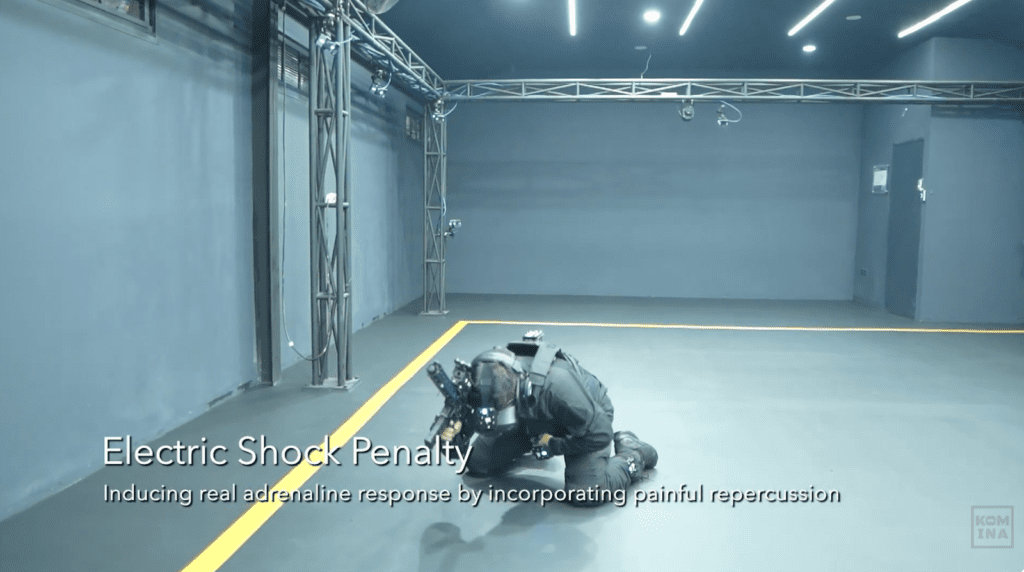
Here is the science behind why our system “shocks” you, and why that is the key to combat readiness.
1. The Psychology of Negative Reinforcement
To train the brain effectively, there must be a feedback loop.
- Visual Feedback: You see the screen turn red. (Weak reinforcement).
- Haptic Feedback: You feel a localized physical sensation—a strong vibration or a measured electric impulse—when you are hit. (Strong reinforcement).
Komina integrates Tactical Haptic Vests that deliver a “pain penalty.” It isn’t dangerous, but it is uncomfortable enough to avoid. This triggers a primal psychological response. The moment an operator realizes that getting hit hurts, their posture changes. Their elbows tuck in tight to their ribs. They “slice the pie” (clear corners) with extreme caution. Communication becomes urgent.
They stop playing a game and start fighting for survival.
2. Stress Inoculation and the “Cortisol Spike”
In a real firefight, fine motor skills degrade drastically. This is due to the release of Cortisol and Adrenaline. Hands shake, tunnel vision sets in, and simply reloading a weapon becomes a clumsy, difficult task.
Traditional training in a calm, air-conditioned room cannot replicate this. By introducing the threat of physical feedback (the shock), Komina artificially induces this stress spike. We force operators to perform complex tasks—like clearing a weapon jam or calling in a SITREP—while their heart rate is elevated and adrenaline is flooding their system.
If they can function under this simulated stress, their chances of functioning when real bullets are flying increase exponentially.
3. Killing the “Run and Gun” Habit
One of the most dangerous habits formed in simulation is aggressive negligence. Without consequences, operators tend to move too fast. They rely on reaction time (reflexes) rather than tactical positioning.
The Komina system penalizes exposure. Because the haptic feedback is directional—you feel exactly where the round hit you (chest, back, or thigh)—operators develop heightened spatial awareness. They learn to minimize their silhouette. They learn to value cover not just as a concept, but as a physical necessity.
Conclusion
Komina is not designed to be comfortable. It is designed to be effective. By bridging the gap between digital simulation and physical sensation, we ensure that when our soldiers deploy, they aren’t just technically proficient; they are psychologically hardened.
We shock you in the simulation so you don’t freeze in the field.
Contact Us
Are You Ready for Realism?
Feel the difference between a game and a weapon system. Contact Komina for a demonstration of our Haptic Tactical Ecosystem.
Email: [email protected]
Phone/WhatsApp: +62 812 9696 7887
Address: Pondok Indah Office Tower 2, Lt. 15 Jakarta Selatan, DKI Jakarta 12310
Website: www.komina.co